Monday, April 24, 2017

Go Carts!

Spontaneous Problem: Name things you would want a robot to do for you.
Boundary Breaker: Interpret the meaning of this quote: "The best way to predict the future is to invent it" - Allan Kay

Today we wrapped up our black box investigation by answering reflection questions and comparing group models to help us land on a scientific consensus.  We then moved to looking at models and design in the development of the automobile.  Students read the article " Early Autos" to learn the history of their development.  They then began the design of their own free rolling go carts that they will revise and race in coming weeks.


Our Habit of Mind focus today was on striving for accuracy and precision.  Students followed detailed steps to complete a calculator magic trick landing them on the digits of their birthday.

Second graders played the game Race in Base.  They used the game cards to make trades in base 10 and then in base 3.  By playing both versions of the game, students were able to draw comparisons between the two systems.

Third graders used Egyptian hieroglyphics to calculate sums and differences and explored difficulties stemming from a system that does not have a symbol for zero.


We also got to spend some time reflecting on our field study experiences and practicing in our brain stretcher packet.

Friday, April 21, 2017

Discovery Place

We had an amazing day with this great crew at Discovery Place!  We began with a computer programming class where students set their robots to accomplish various challenges and follow their commands!  In our catapults class, we learned about the laws of motion and got to design our own launching devices.  Exploring the museum, students were able to explore many simple machines in the Cool Stuff lab.  They also had the chance to experience virtual reality, learn some ancient history, and get their hands wet in the aquarium.  They were all impressed with the IMAX experience which fit perfectly with our archaeology focus from earlier in the year.  They also enjoyed the live performance of "Zapped"  where they got to meet Thomas Edison and Nikola Tesla and learn about their inventions in the field of electric current.


Monday, April 3, 2017

Take 17

Spontaneous Problem:  Name things that make work easier.
Boundary Breaker: What is something that you think will not exist in 20 years?  Why will it be unnecessary and what will take its place?

Today student took their conceptual black box models and built them into physical models to test. As they gathered more information from their prototypes, they drafted new versions of the model to build. They collaborated and compared models with classmates, honed their senses as observers, and demonstrated persistence on their many attempts!


We took some time for self reflection and goal setting and also review expectations and details for our upcoming Discovery Place field study.

Second graders practiced subtraction and regrouping in base 3 as well as how to read numbers and covert between systems!


Monday, March 27, 2017

Black Boxes

Spontaneous Problem: Name things that go back and forth
Boundary Breaker:  Students watched a short video about predictions for technology in the future. They responded with any potential problems they saw for the devices or society as a whole adapting to the new developments.

We practiced the Habit of Mind Listening to Other with Understanding and Empathy by using the video to discuss the coolest/most important technology shown.  Groups took up roles as speaker, listener, and evaluator as they practice whole body listening and received feedback.


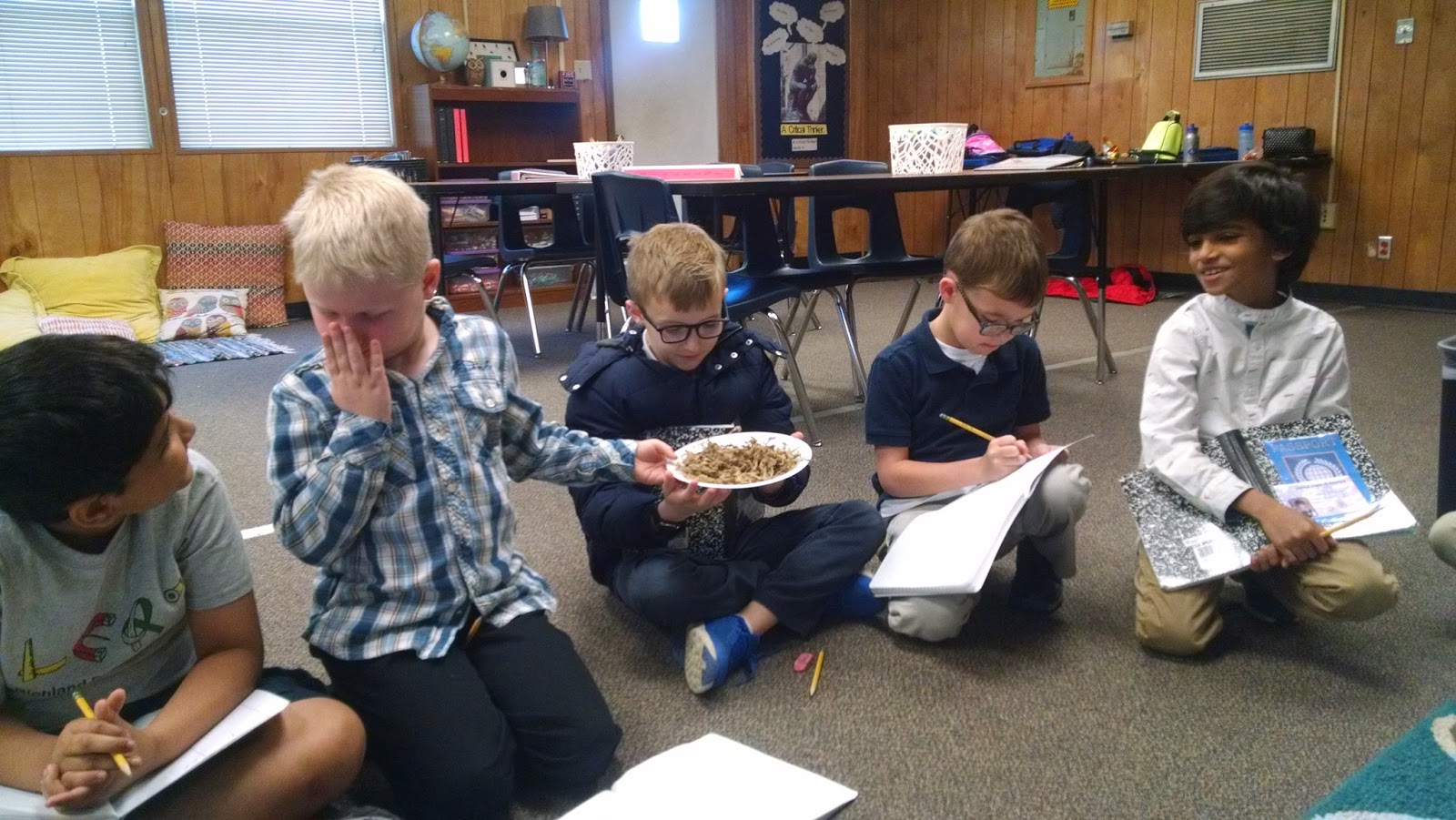
Next we reviewed our observations and inferences lesson from last week as students collected qualitative and quantitative data for our dancing raisin experiment.  Students then made inferences about the objects them selves and their interactions.  They used prior knowledge to conclude that the wrinkled brown objects were raisins being lifted by the bubbles in the carbonation until they popped and sunk again.


We also went back to our discussion of models as students looked at their actual black boxes and drew they conceptional models for what they thought was inside.  Groups with the same boxes then paired to share ideas and update their designs as they found new information.  They will continue on this investigation as they turn their conceptual models into physical ones and continue to update their theories and designs.  We also read the article "Scientists and Models" and were able to discuss how the same process was and is being used to continually revise our understanding of the black box that is the solar system.


We also had a little time for students to dive into some brain stretchers of their choice.

Second grade math time was spent visiting the Land of Treble where they use a base 3 number system. Students practiced making trades among their place values and played a dice game to be the first player to reach 1 Trickle!


For third grade math, we jumped in to exploring the Egyptian numeration system.  Students discussed the use of symbols and got to work decoding amounts with their knowledge of hieroglyphics.  They compared our place value system with that of the Egyptians where the order of symbols does not effect the value of the number.

Monday, March 20, 2017

Models and Design

Spontaneous Problem: Write scientific observations about this object.
Boundary Breaker: Make an inference about what the object is and how it came to be in our classroom.

We used our Morphic Thinking this morning to lead us into some discussion and activities highlighting the difference between observations and inferences in science.  Students learned the observations are made with the five senses and simply describe.  We classified our observations as qualitative or quantitative and defined each term.  Then we looked at inferences as connections your brain makes when you mix your observations with prior knowledge.  Inferences are theories explaining the world around you.  We used several prompts and images to practice distinguishing between the two.

 Next we started our investigation of the use of models in discovery.  We read the article, "Everyday Mysteries" highlighting black boxes as the terms for systems that are hard to see and explain.  Models are tools used to show explanations of these mysterious inner workings. Students also read The Dinosaurs of Waterhouse Hawkins and learned how models develop over time and change with new information.  Students were then introduced to their own black boxes.  In future weeks, they will be working to observe these hidden systems and create their own models explaining what is happening inside the box. Just like scientists don't have a cheat sheet that can be checked at the end of the day, students will prove or disprove their hypothesis just from comparing models and never actually open the box!


We finished with some final student presentations and had fun practicing the Habit of Mind, Thinking Flexibly with the Hidden Squares Challenge puzzle and Persisting with the Penny Balance Challenge.


Monday, March 13, 2017

Inventor Projects and Breakout Boxes!

Spontaneous Problem: Name things you have to break in order to use.
Boundary Breaker: What would you like to be famous for inventing?

Today we got to see all the amazing hard work of our peers as we presented our inventions projects! I know I learned a lot!  Thanks for all the effort that was put into those at home!


We also reviewed our understanding of simple machines with a break out activity.  Students loved solving puzzles and cracking codes to discover what simple machine had been taken from our classroom!


For our brain stretching we looked at reasoning strategies to help us solve Sudoku puzzles.  We also learned a little about the life and work of Albert Einstein to help us prepare for his birthday party later this month!